If you are serious about FMGE clinical subjects preparation, you already know one thing: not every subject deserves the same number of hours. Out of 300 marks, a full 200 come from clinical subjects, and if you spread your time evenly across all of them, you are going to run out of days before you run out of syllabus.
Where the marks are, in short
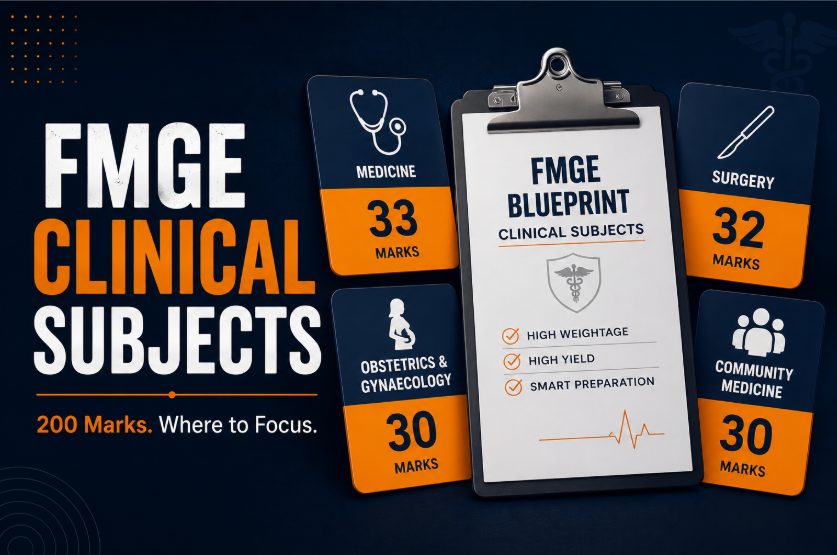
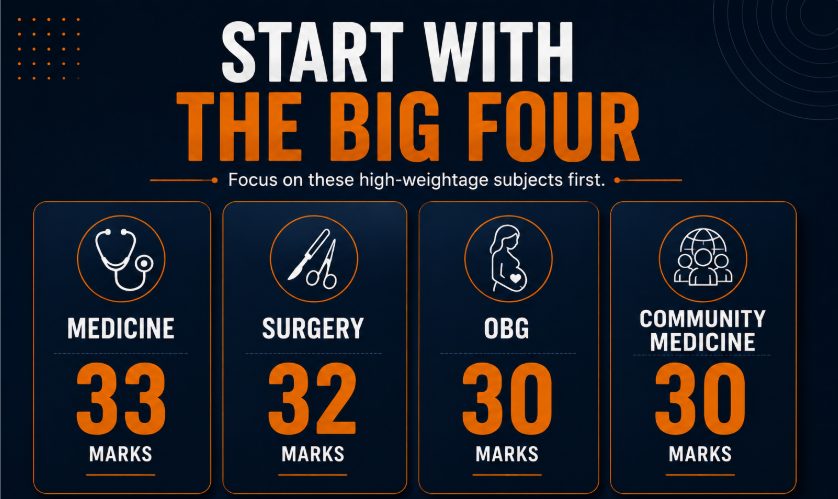
Clinical subjects carry 200 of 300 marks. The big four, Medicine (33), Surgery (32), Obstetrics & Gynaecology (30) and Community Medicine (30), make up 125 marks on their own. Paediatrics, Ophthalmology and ENT add 45 (15 each), and the six 5-mark subjects add another 30. Start with the big four, then build the rest around them.
This guide breaks down exactly which clinical subjects carry the most weight in the Foreign Medical Graduate Examination (FMGE), how the marks are actually distributed, and how you should be preparing each one. No fluff, no generic study-hard advice. Just the numbers and the strategy that comes with them. If you are still getting familiar with the exam itself, start with our complete beginner's guide on what FMGE actually is.
Why clinical subjects deserve most of your attention
FMGE is a single paper with 300 multiple-choice questions, split into two parts of 150 questions each, and there is no negative marking. You need 150 out of 300 to pass. Out of those 300 marks, pre-clinical and para-clinical subjects such as Anatomy, Physiology, Biochemistry, Pathology, Microbiology, Pharmacology, and Forensic Medicine together account for 100 marks.
The remaining 200 marks come entirely from clinical subjects. That is two-thirds of your entire score sitting in one basket. If you have limited revision time left, this is the basket you fill first. Here is the official subject-wise blueprint published by the National Board of Examinations in Medical Sciences (NBEMS) for FMGE.
| Subject | Marks |
|---|---|
| Medicine | 33 |
| General Surgery | 32 |
| Obstetrics & Gynaecology | 30 |
| Community Medicine | 30 |
| Paediatrics | 15 |
| Ophthalmology | 15 |
| Otorhinolaryngology (ENT) | 15 |
| Psychiatry | 5 |
| Dermatology & STD | 5 |
| Radiotherapy | 5 |
| Anaesthesiology | 5 |
| Orthopaedics | 5 |
| Radiodiagnosis | 5 |
| Total | 200 |
For a broader look at how clinical, pre-clinical, and para-clinical subjects compare, read our guide on FMGE syllabus high-weightage subjects. That table alone tells you where to start. Let us go through the heavy hitters one by one.
Medicine: the single biggest subject
Medicine sits at the top with 33 marks, and honestly, it deserves to be treated like a subject on its own rather than something you squeeze in between other topics. It also connects to almost everything else you study, so strong Medicine concepts make Surgery, Paediatrics, and even Pharmacology easier to remember.
Focus your energy on
- Cardiology (ECG basics, heart failure, valvular disease)
- Endocrinology (diabetes, thyroid disorders)
- Gastroenterology and hepatology
- Nephrology (renal failure, electrolyte imbalance)
- Infectious diseases (this overlaps heavily with Microbiology, so revise them together)
- Neurology basics (stroke, seizures, common neuropathies)
When you prepare Medicine, do not just read textbook chapters end to end. Build small clinical scenarios in your head. If a patient presents with a certain set of symptoms, what is the most likely diagnosis, and what is the next best step? This approach can help you apply concepts more confidently when questions are presented as clinical scenarios.
General Surgery: almost as important as Medicine
With 32 marks, General Surgery is right behind Medicine, and a lot of students underestimate it because it feels less conceptual than Medicine. That is a mistake. Surgery questions in FMGE often test practical, applied knowledge rather than pure theory.
Prioritise these areas
- Abdominal surgery basics (hernias, acute abdomen, appendicitis)
- Trauma and shock management
- Surgical oncology basics (breast, thyroid, GI cancers)
- Urology essentials
- Wound healing and surgical infections
- Pre-operative and post-operative care
A good trick here is to link Surgery topics with their related Radiodiagnosis and Anaesthesiology questions. Since these smaller subjects carry only 5 marks each, you get more return on your revision time by studying them alongside the surgical conditions they are commonly tested with, instead of treating them as separate silos.
Also, do not ignore the basic surgical instruments and procedures section. FMGE occasionally throws in a question about a common procedure or instrument that catches students off guard simply because it feels too practical to be exam material. If you have clinical exposure from your internship, use it here. Real ward experience often makes these questions feel obvious rather than tricky.
Obstetrics and Gynaecology: a high-yield, high-return subject
OBG carries 30 marks, and here is the good news: it is one of the most learnable subjects on this list. The syllabus is well defined, the number of high-yield topics is limited, and if you put in focused hours here, your score improves fast.
What to prioritise
- Normal labour and its stages
- High-risk pregnancy and antenatal complications
- Postpartum haemorrhage and other obstetric emergencies
- Contraception methods
- Common gynaecological cancers (cervical, ovarian, endometrial)
- Menstrual disorders
OBG can be a rewarding subject to revise because many topics are structured, high-yield, and easier to revise in a focused way. If your time is tight, this subject offers one of the best marks-per-hour ratios in the entire syllabus. One more tip: draw out the stages of labour and the management steps for common obstetric emergencies on a single page. Visual summaries like this work far better than paragraphs of text when you are trying to recall a sequence of steps under exam pressure.
Community Medicine: do not skip this one
Community Medicine also carries 30 marks, tied with OBG, and yet a lot of aspirants push it to the last week of preparation because it feels theoretical. That approach usually backfires. Community Medicine is largely about memorising facts, numbers, programmes, and definitions, which actually makes it one of the easiest subjects to score well in if you revise it properly.
Focus on
- National health programmes (immunisation schedule, vector-borne disease control programmes)
- Epidemiology basics (types of studies, measures of disease frequency)
- Biostatistics fundamentals
- Nutrition and public health
- Maternal and child health indicators
Because this subject is fact-heavy, flashcards and short daily revision cycles work better here than long reading sessions. Revisit the same set of numbers and programme names every few days instead of trying to memorise them once and moving on. Try keeping a single running sheet where you jot down every programme name, target age group, and key statistic as you come across them. By the time you are done with your first full read-through, that sheet becomes your best friend for quick revision in the final week.
Paediatrics, Ophthalmology, and ENT: the middle tier
Each of these three subjects carries 15 marks, which puts them in a comfortable middle ground. They are not big enough to dominate your schedule, but they are far too significant to ignore.
Paediatrics overlaps closely with Medicine and Community Medicine, especially around growth milestones, immunisation, and nutrition. If you have already revised those topics in Community Medicine, Paediatrics becomes much faster to cover. Ophthalmology tends to be very image and diagram dependent. Focus on common conditions such as cataract, glaucoma, and refractive errors, and make sure you can identify their key clinical features, not just recall their definitions. ENT often tests common, everyday conditions like otitis media, sinusitis, and epistaxis. These are the kinds of topics that come up in real clinical practice too, so they tend to stick in memory once you connect them with a mental picture of an actual patient.
Together, these three subjects add up to 45 marks, which is more than Community Medicine or OBG on their own. Treat them with the same seriousness you give to the bigger subjects, just in a smaller time window.
The smaller subjects: do not let them slip
Psychiatry, Dermatology & STD, Radiotherapy, Anaesthesiology, Orthopaedics, and Radiodiagnosis each carry only 5 marks. Individually, they look small, but added together, they total 30 marks, which is the same weight as OBG or Community Medicine. The smart move here is not to ignore them, but to prepare them efficiently. Stick to high-yield, commonly asked topics rather than trying to master the entire subject.
- Psychiatry: mood disorders, schizophrenia basics, commonly used drug classes.
- Dermatology: common skin infections, drug reactions, basic STD identification.
- Orthopaedics: fracture classification basics, common orthopaedic emergencies.
- Anaesthesiology: types of anaesthesia, basic pharmacology of anaesthetic agents.
- Radiodiagnosis and Radiotherapy: imaging basics linked to Medicine and Surgery topics you are already studying.
Because these are low-weightage subjects, keep their revision focused on high-yield topics so they do not take time away from larger subjects. Do not let them eat into the time you need for Medicine and Surgery. A common mistake is treating all six of these subjects as equally important as the big ones just because every mark counts. Every mark does count, but your hours do not stretch infinitely. Spending a full week on Radiotherapy when you could have used that time to strengthen Medicine is not a good trade. Keep these subjects tight, focused, and fact-driven, then move on.
How to actually structure your clinical subjects preparation
Knowing the marks distribution is only half the job. Here is how to turn that knowledge into a working study plan.
- Start with the big three
Medicine, Surgery, and OBG together make up almost half of your total FMGE score. Build your first full revision cycle around these three subjects before moving to anything else.
- Group related subjects together
Study Medicine with Pharmacology and Microbiology, since infectious disease and drug questions overlap constantly. Study Surgery with Anaesthesiology and Radiodiagnosis for the same reason. This saves time because you are not learning the same clinical picture twice.
- Use previous-year trends to guide revision
Subject weightage tells you where the marks are, but recent trends tell you where examiners are placing emphasis right now. If certain topics have been repeating in recent papers, prioritise those first. Our guide on FMGE previous year question trends can help.
- Practise MCQs subject by subject
After you finish a topic, solve a focused set of questions from that topic alone before mixing subjects. This reinforces recall far better than jumping between unrelated topics in a single session.
- Revise low-weightage subjects in short blocks
Do not spread Psychiatry or Dermatology across your entire timeline. Pick a few days closer to your final revision phase, cover the high-yield points, and move on.
A simple weekly framework you can follow
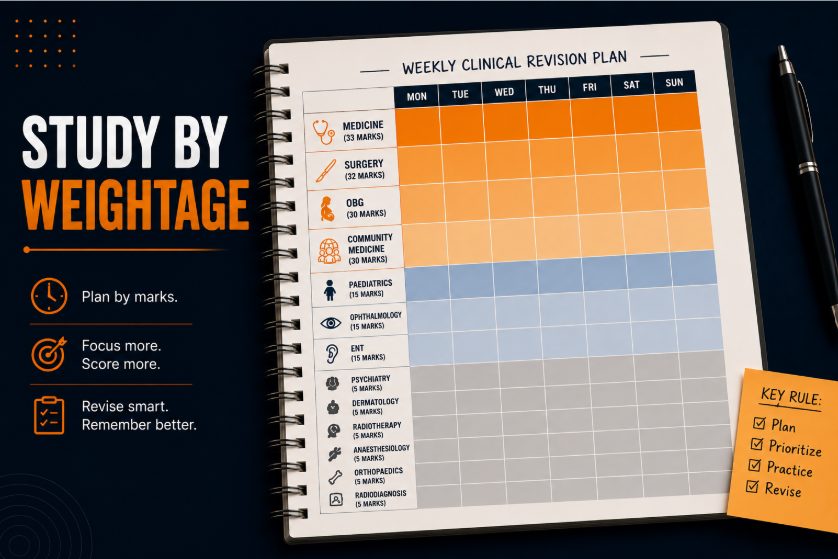
If you are wondering how to fit this into a weekly routine, here is one simple structure you can adapt.
- Two days a week: Medicine (rotate through cardiology, endocrinology, nephrology, infectious disease).
- Two days a week: Surgery (rotate through GI surgery, trauma, oncology, urology).
- One day a week: OBG.
- One day a week: Community Medicine.
- One day a week: rotate through Paediatrics, Ophthalmology, ENT, and the smaller 5-mark subjects.
This is not a rigid rulebook, and you should adjust it based on how confident you already feel in each subject. If your Surgery is weak and your Medicine is strong, shift the balance accordingly. The goal is to make sure the 200 clinical marks always get the lion's share of your weekly hours. As your exam date gets closer, shift this framework from learning mode to testing mode. In the last month, spend less time reading new material and more time solving timed question sets, subject by subject. This helps you spot which topics still trip you up while there is still time to fix them, instead of finding out on exam day.
Final thoughts on FMGE clinical subjects preparation
FMGE is not about knowing everything. It is about knowing the right things well enough to answer confidently under time pressure. Since clinical subjects make up two-thirds of your total score, your preparation strategy should reflect that from day one, not just in the final month before the exam.
Start with Medicine, Surgery, OBG, and Community Medicine since they cover the bulk of the marks. Build Paediatrics, Ophthalmology, and ENT around them. Handle the smaller 5-mark subjects in short, efficient bursts closer to your revision phase. And throughout it all, keep testing yourself with MCQs so you are not just reading; you are actually applying what you know the way the exam expects you to. For the most accurate and updated syllabus details, always cross-check with the official NBEMS FMGE information bulletin before finalising your study plan.
Ready to revise faster? Get our Clinical Quick-Revision Notes and go into your final weeks with a clear, subject-wise checklist instead of guesswork.
Get the Clinical Quick-Revision Notes