Ask any FMGE aspirant what scares them most about exam day, and a lot of them will not say the syllabus. They will say the clock. 300 questions. Two parts. 150 minutes each. And once a time-bound section closes, there is no going back to fix anything.
Finishing on time, in short
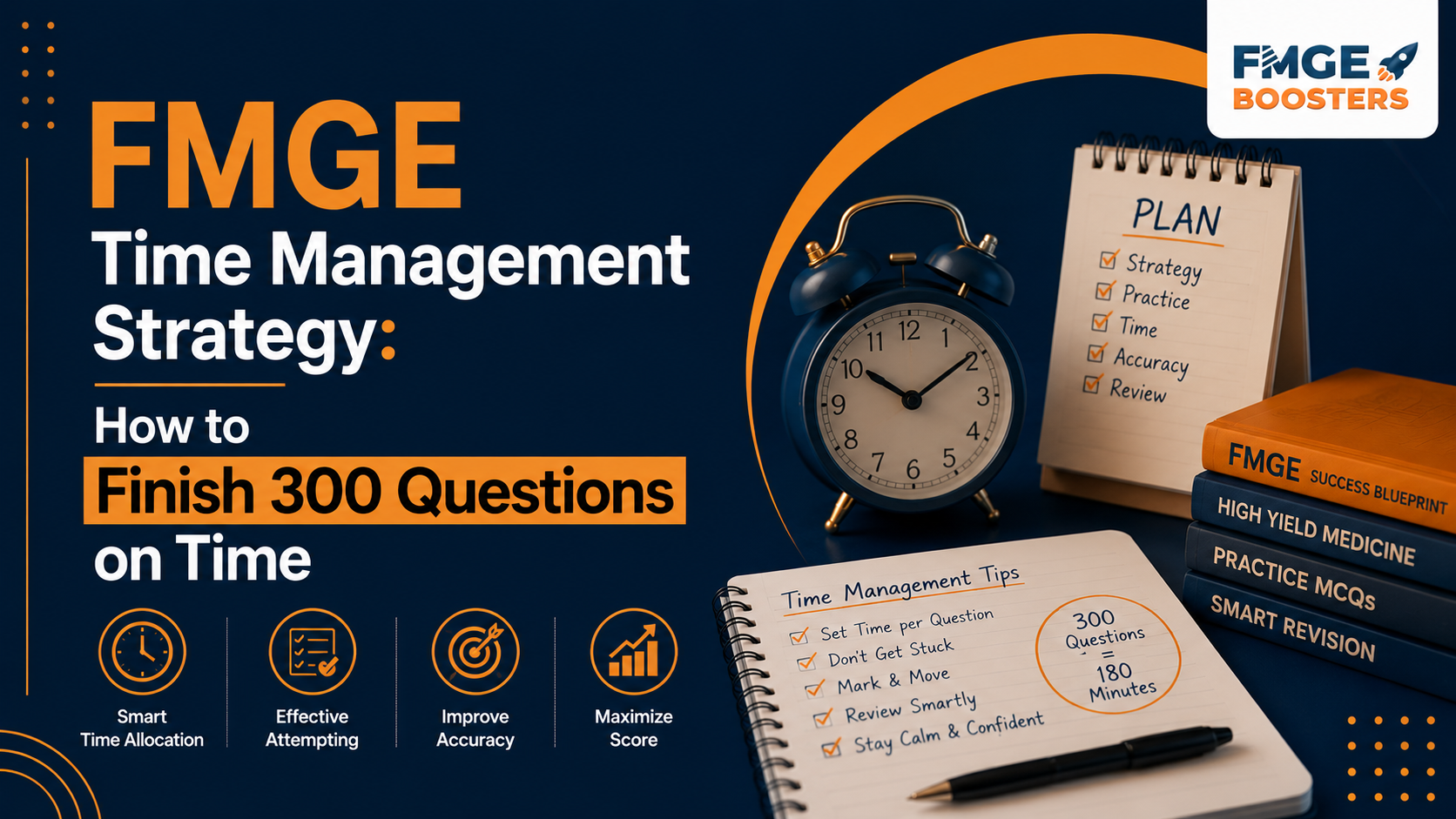
FMGE gives you roughly one minute per question. Treat that as a budget, not a rule: clear easy questions in 15 to 20 seconds to bank time for clinical vignettes. Time every practice set, read the last line of a vignette first, reset during the break, and never let one hard question eat the time meant for five easier ones. With no negative marking, always attempt every question.
The students who finish all 300 questions calmly, without that frantic last-ten-minutes scramble, are not necessarily the ones who know more. They are the ones who treated time as something to train, not something to worry about on the day. This blog breaks down exactly how that training works.
Why time management decides FMGE more than people realise
Let us do the math first, because the numbers tell you everything. FMGE is divided into two parts, each with 150 questions to be completed in 150 minutes. That is exactly one minute per question, on average, across the whole exam. Each part is further broken into time-bound sections. If a section has 50 questions, you get 50 minutes for it. Once that time is up, the next section opens automatically, and you cannot return to review or change anything in the closed section.
This means one thing very clearly: knowledge without pace is not enough. You can know the answer to a question and still lose the mark if you do not reach it in time. This is exactly why so many genuinely capable students underperform on FMGE. They know the subject. What they have not trained is the rhythm of moving through 150 questions without getting stuck, without re-reading the same stem three times, and without letting one tough question eat into the time meant for five easier ones.
Toppers are not necessarily faster readers or sharper thinkers. They have simply built a system, and that system is what this blog is going to walk you through.
The one-minute rule, and why it is not actually about one minute
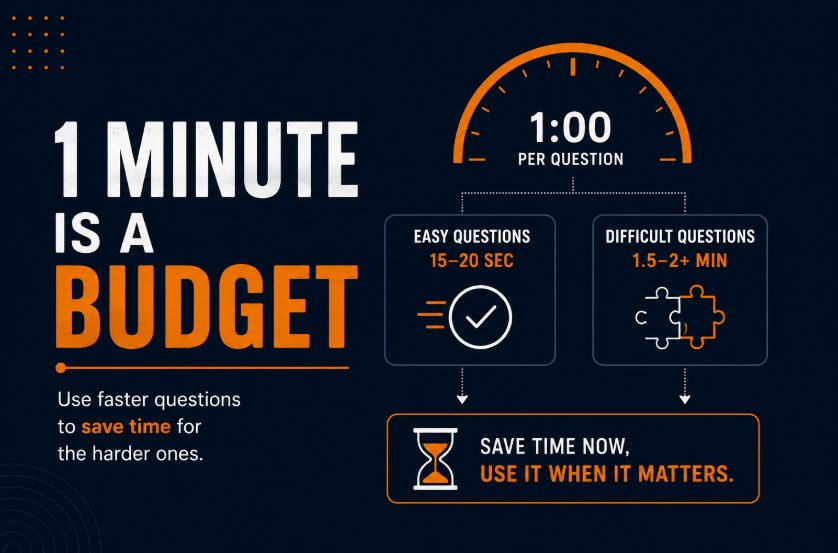
People hear "one minute per question" and assume every single question should take exactly sixty seconds. That is not how it works in practice, and trying to force that rigidly will actually hurt you. Some questions, especially direct recall ones in Anatomy, Physiology, or Pharmacology, take fifteen to twenty seconds. You read the stem, you know the answer, you mark it, you move on. Other questions, particularly clinical vignettes in Medicine or Surgery that describe a patient scenario before asking for a diagnosis or next step, genuinely need more time to process.
The real skill is not uniform pacing. It is using your faster questions to bank time for your slower ones. Toppers mentally treat the one-minute average as a budget, not a rule. If you are 25 questions into a 50-question section and you have used only 18 minutes, you are ahead. That surplus is now available for the harder questions still to come. This is exactly the kind of pacing awareness that separates students who finish comfortably from students who are still on question 130 when the section timer hits zero.
Practise with a timer from day one, not just before the exam
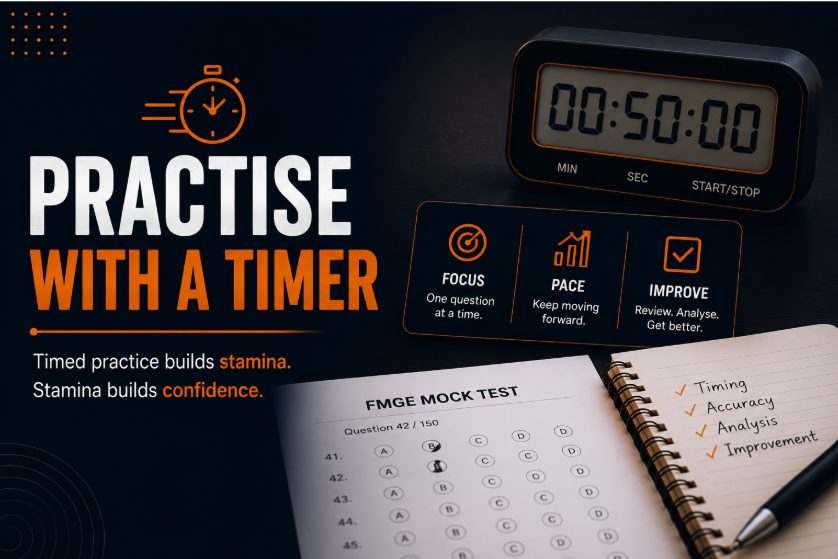
A mistake a lot of students make is treating timed practice as something you do only in the final month before the exam, as a kind of dress rehearsal. By then, it is mostly too late to build real pacing instincts. Timing should be part of your practice much earlier. Even when you are doing subject-wise MCQs during your initial preparation phase, use a timer. You do not need to simulate full exam conditions every single day, but you should always have a sense of how long you are taking per question.
As you get more comfortable, start doing full timed sections, 50 questions in 50 minutes, then eventually full 150-question parts in 150 minutes. This builds the stamina and mental endurance needed to stay sharp for the full duration, not just the first hour. By the time you are within four to six weeks of your exam date, you should be doing full-length timed mock tests that simulate both Part I and Part II with the scheduled break in between, exactly as the real exam is structured. This stage of preparation needs to be planned well in advance so your timing practice is not rushed at the end.
If you are still building your overall FMGE preparation plan, our guide on How to Prepare for FMGE can help you structure your study schedule more effectively.
Know where you lose time, and fix that specifically
Not all students lose time in the same way. Some genuinely take too long reading long clinical vignette questions. Others know the content well but waste time being indecisive between two close options. Some lose time simply from anxiety, rereading the same line multiple times without absorbing it. Identifying your specific time-loss pattern is far more useful than generic advice to go faster.
Here is how to figure out yours. During your next few practice sessions, keep a simple log. Note down which questions took you noticeably longer than average, and afterward, ask yourself why. Was it the length of the question? Was it because you were unsure between two options? Was it because the topic itself was unfamiliar?
Match the fix to the cause
- Unfamiliarity: that is a content gap, and it needs to be fixed through revision, not faster reading. Our blog on Build Strong Concepts Instead of Memorising for FMGE explains how to strengthen weak concepts instead of repeatedly revising facts without understanding them.
- Indecision between two close options: that is an elimination-skill gap, and it improves with deliberate practice of ruling out wrong choices confidently.
- Length of clinical vignettes: train yourself to read the last line of the question first. In most clinical MCQs, the actual question being asked is in the final sentence. Reading that first tells you exactly what information in the stem matters, so you read the rest of the paragraph with purpose instead of absorbing everything equally.
Use the break between Part I and Part II wisely
FMGE gives you a scheduled break between the two parts of the exam. Do not underestimate how important this gap is for your time management in the second half. Use the break to genuinely reset. Step away mentally from Part I, whatever happened in it. Many students spend the break replaying questions they were unsure about, which only adds stress heading into Part II. That mental energy is better spent on eating something light, hydrating, and calming down.
When Part II begins, treat it as a fresh exam. Focus on the questions in front of you instead of carrying uncertainty from Part I into the next half. Do not let fatigue from Part I cause you to slow down unnecessarily in the second half. This is exactly why building stamina during your mock test practice matters so much. If your practice has only ever simulated single 150-question sittings, the second part on exam day can catch you off guard.
Speed without accuracy is a trap
Here is something worth being honest about. It is entirely possible to finish all 300 questions on time and still score poorly, because speed and accuracy are not the same skill, and chasing one without the other will not get you past the 150-mark cutoff.
Toppers do not just move fast. They move fast through what they know and slow down deliberately for what they do not, using elimination instead of guesswork. That balance only comes from genuinely strong preparation paired with good pacing habits, not from either one alone. If your mock test scores show you finishing comfortably within time but still missing marks, the issue is not your speed. It is your accuracy, and that needs a different kind of focused work.
Our guide on how to solve FMGE MCQs accurately goes into the specific habits, like maintaining a mistake notebook and tracking your error patterns, that close this gap directly.
Conclusion
Time management on FMGE is not about racing through 300 questions as fast as possible. It is about building a pace that helps you answer confidently and move on when a question is taking too long. Start training this now, not in the final week. Use a timer in every practice session. Practise working within the time available. Track where you personally lose time and fix that specific gap.