If you have been preparing for FMGE for even a few weeks, you have probably heard someone say, just solve previous year papers. It is good advice, but it is also incomplete. The difference between aspirants who benefit and those who do not is not how many questions they solve. It is how they learn from them.
How to use PYQs, in short
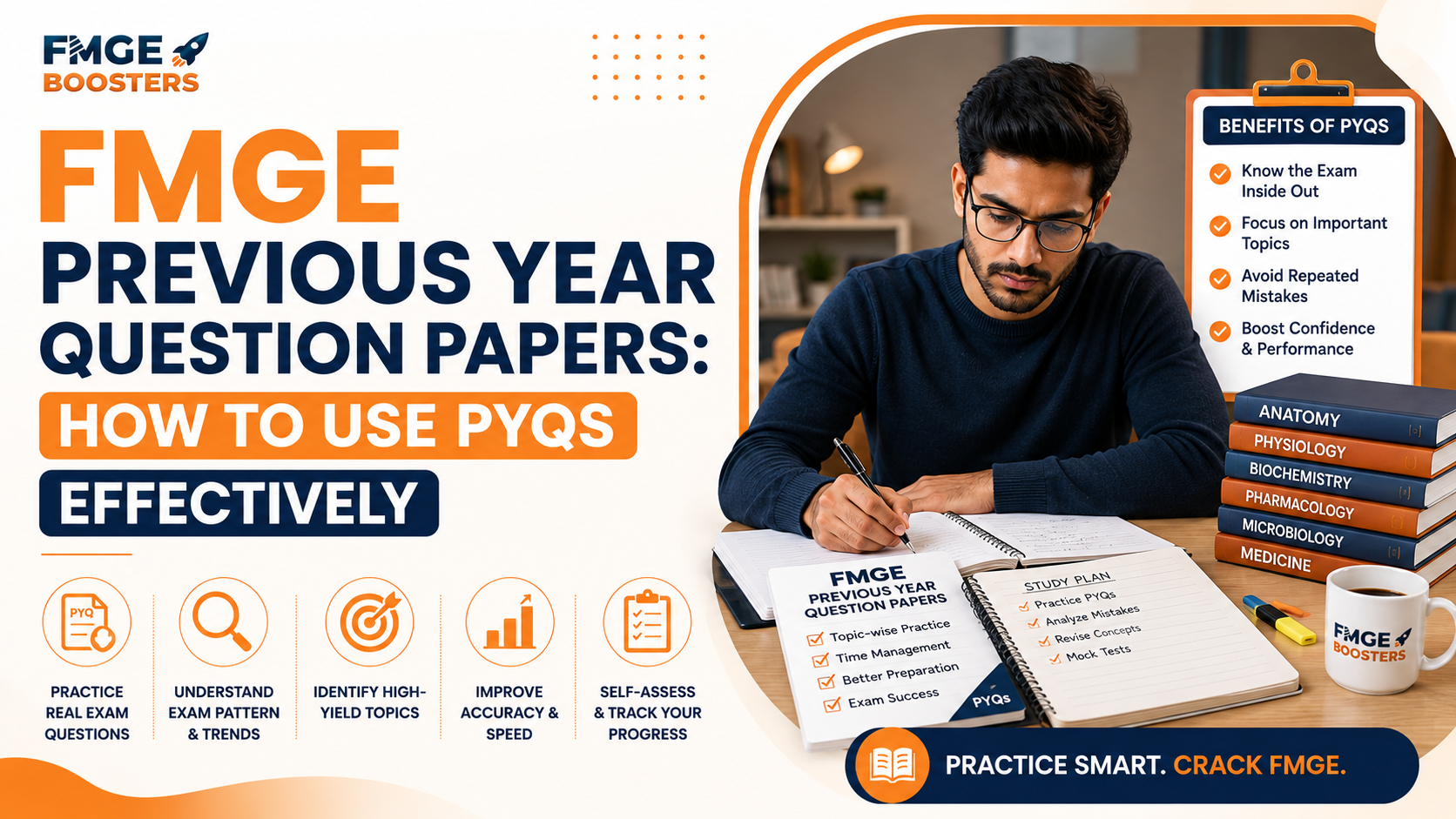
Treat FMGE previous year papers as a learning tool, not a memory exercise. Use them at every stage: a few after each topic while learning, subject-wise during revision, and timed sets near the exam. After every question, understand why the answer is correct and why the others are wrong, and log your mistakes so your next revision starts exactly where your gaps are.
FMGE previous year question papers are much more than a collection of old MCQs. They help you understand how the exam thinks: which concepts return repeatedly, how clinical scenarios are framed, and where your preparation still has gaps. If you know how to use them properly, PYQs become one of the most valuable tools in your preparation. If you are just beginning, start with our What Is FMGE? guide to understand how the examination is structured before building your study strategy.
Why are FMGE previous year question papers so important?
Every competitive exam develops its own pattern over time, and FMGE is no different. While the exact questions are unlikely to be repeated, the concepts behind them often are. That is what makes previous year papers such an important part of your preparation: they give you a clearer idea of the topics NBEMS considers important and the kind of clinical thinking expected from candidates.
As you solve more papers, you will begin to notice recurring themes. Certain diseases appear repeatedly, investigations are tested from different angles, and common clinical scenarios keep showing up in different forms. That does not mean you should expect the same questions in your exam. It simply means you start recognising what deserves extra attention during revision. Previous year papers also help you become familiar with the overall difficulty level, so instead of walking into the exam hall wondering what the questions will look like, you already have a realistic idea of what to expect. That confidence can make a significant difference on exam day. If you are wondering which subjects and concepts appear repeatedly, our guide on Previous Year Trends breaks down the topics that have consistently been tested and can help you prioritise your revision.
What can you learn from FMGE PYQs?
Many students treat previous year question papers as something to solve only after finishing the syllabus. In reality, they are useful throughout your preparation. Even if you are still studying a subject for the first time, solving a few previous year questions shows you how that topic is actually tested in FMGE. It gives context to your preparation and helps you focus on concepts that are repeatedly examined.
More importantly, PYQs train you to think like the examiner. Over the years, FMGE has gradually moved beyond testing simple factual recall. Many questions now expect you to apply your knowledge to a clinical situation rather than simply remember a definition or isolated fact. Previous year papers help you become comfortable with this style of questioning and improve your clinical reasoning alongside your factual knowledge.
Previous year papers also become an excellent self-assessment tool. Every incorrect answer tells you something about your preparation. Sometimes it is a concept you have not fully understood, sometimes a topic you have not revised in a while, and occasionally just a careless mistake. Either way, every mistake tells you where your next revision session should begin. Solving PYQs becomes even more effective when you pair them with a structured approach; our guide on how to solve FMGE MCQs explains how to approach different question types and avoid common mistakes.
Do not memorise questions. Learn the concept behind them.
This is where many FMGE aspirants lose the real value of previous year papers. The goal is not to memorise hundreds of answers and hope they appear again. The goal is to understand why the answer is correct.
A previous paper may ask about the investigation of a disease. A future paper may describe a patient with the same condition but ask for the next step in management instead. The wording has changed, but the concept remains the same.
That is why you should spend more time analysing a question than simply checking whether you got it right. After solving every PYQ, pause for a moment and ask yourself why the correct option is correct, why the remaining options are incorrect, and how the same concept could be tested differently. That extra minute of analysis teaches you far more than rushing through another twenty questions. Over time, this builds strong conceptual understanding instead of short-term memory, and that is exactly what helps you handle unfamiliar questions on the actual exam.
Quick guide: how to use PYQs at every stage of preparation
Previous year papers earn their place at every phase of your preparation, not just the final weeks. Here is how to use them stage by stage.
| Stage of preparation | How to use PYQs |
|---|---|
| First reading | Solve a few questions after each topic to understand how concepts are tested. Do not worry about your score. |
| During revision | Solve subject-wise PYQs and identify topics that keep appearing across different sessions. |
| Final month | Attempt mixed question sets under timed conditions to improve speed and accuracy. |
| Last week | Revise incorrect questions, weak concepts and your personal mistake notes instead of repeatedly solving the same papers. |
Solving PYQs is only half the job
Working through previous year question papers is important, but simply solving more questions does not always translate into a better score. The real improvement comes from what you do after you finish a paper.
One of the biggest mistakes students make is treating PYQs like a memory exercise. The aim is not to remember that option C was correct in a particular paper. It is to understand the concept behind the question so you can answer it even if the examiner presents it in a completely different way. Another common mistake is solving papers passively: reading the explanation, agreeing with it, and immediately moving on feels productive, but very little learning actually happens. If you get a question wrong, spend a few minutes revisiting that topic from your notes before continuing. That small investment of time helps prevent the same mistake from happening again.
Students also often ask how many previous year papers they should solve. There is no fixed number; what matters far more is how well you analyse each paper. If you solve ten papers without reviewing your mistakes, you are likely to repeat the same errors. Carefully analysing five papers, revisiting the related concepts, and tracking your weak areas will contribute much more to your preparation. As the exam gets closer, start attempting papers under timed conditions. The FMGE consists of two computer-based papers conducted in separate sessions on the same day, so practising within a fixed time limit helps you improve both speed and decision-making. Most importantly, do not leave PYQs until the final few weeks. Use them throughout: early on to understand how concepts are tested, during revision to identify weak areas, and closer to the exam to assess your readiness and build confidence.
Make PYQs a part of your revision, not your entire preparation
FMGE previous year question papers are one of the most valuable revision tools you have, but they should never become your only source of preparation. Use them alongside your notes, standard study resources, and mock tests. Think of PYQs as a way to measure how well you have understood a topic rather than a shortcut to completing the syllabus.
As your preparation progresses, you will notice that many concepts begin to feel familiar. That is exactly what you want, not because you have memorised old questions, but because you have revised the underlying concepts often enough to recognise them from different clinical angles. That is when previous year papers have truly done their job.
Conclusion
FMGE previous year question papers are much more than a collection of old MCQs. They help you identify high-yield concepts, understand the style of the examination, improve your clinical reasoning, and evaluate your preparation honestly. Instead of rushing through one paper after another, focus on understanding why each answer is correct, analysing your mistakes, and revisiting the concepts that need more attention. Over time, this habit builds confidence and strengthens your preparation far more than simply increasing the number of questions you solve. Remember, clearing the FMGE is not about recognising old questions. It is about understanding concepts well enough to answer new ones with confidence.
Ready to practise smarter? Download our FMGE PYQ Practice Pack from FMGE Boosters and start solving previous year questions with a structured strategy designed to help you identify weak areas, improve your clinical thinking, and revise more effectively.
Get the FMGE PYQ Practice Pack