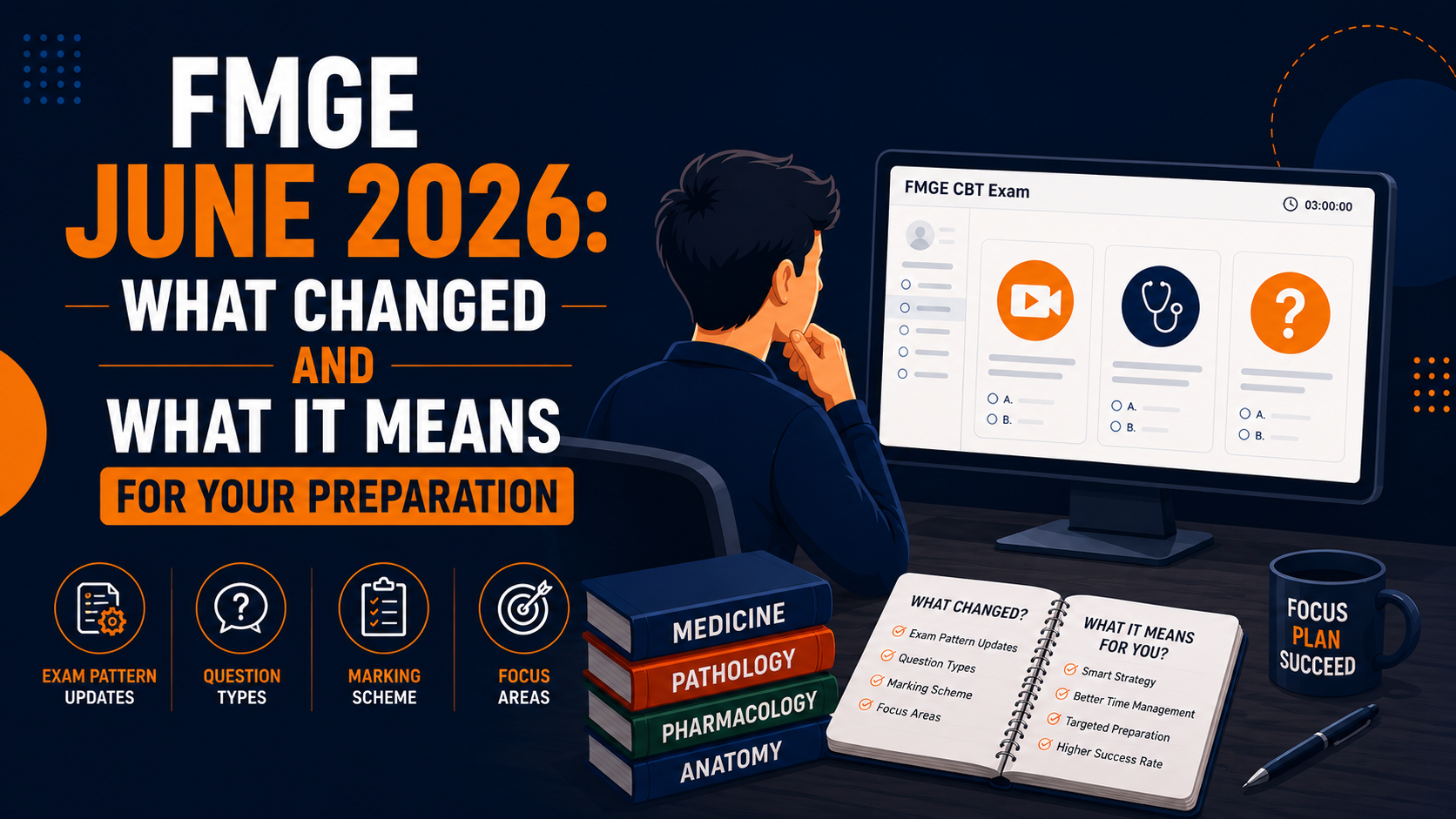
Talk to anyone who appeared for the FMGE on 28 June 2026, and you will hear a similar reaction: it did not feel like the usual paper.
In short
The FMGE June 2026 syllabus did not change, but candidates reported that it tested familiar concepts in new ways. The two biggest shifts: questions that integrate concepts across multiple subjects in a single item, and a move away from one-liner recall questions towards application-based thinking. You do not need new resources — you need to revise diseases as complete topics, keep disease-based notes, and push every practice question one step past the fact.
The syllabus had not changed. The subjects were the same. But many candidates felt the exam was testing familiar concepts in unfamiliar ways. One of the biggest talking points was the introduction of video-based questions, which we cover in detail in our guide on video-based questions in FMGE June 2026. But that was not the only change candidates reported.
Many also noticed questions that required them to connect concepts across multiple subjects, and a shift away from straightforward one-liner questions towards more application-based thinking. Understanding these changes can help you prepare more effectively for future FMGE sessions without changing what you study, only how you study it.
Questions started testing integration, not isolated facts
One of the biggest changes candidates noticed was not the topics being asked. It was how those topics were connected within a single question. In previous FMGE sessions, many questions could be answered by recalling one specific fact. If you knew the diagnosis, the drug of choice, or the correct investigation, you could usually answer and move on.
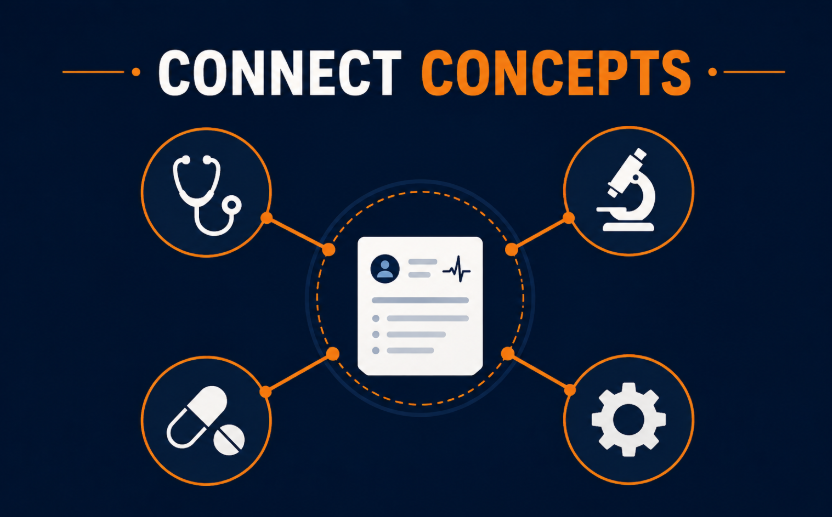
According to feedback shared after the June 2026 FMGE, several questions took an extra step. Instead of testing a single fact, they required candidates to connect multiple concepts before arriving at the answer. For example, instead of simply asking for the drug of choice, a question might describe a disease and then ask about the mechanism of action of the most appropriate drug. To answer correctly, you first needed to recognise the disease, identify the correct treatment, and then understand why that treatment worked.
Candidates also described questions where reaching the diagnosis was only the beginning. Once you identified the condition, the question moved one step further by asking about the next investigation, management, or another related concept. That is a different way of testing the same syllabus. Rather than recalling one isolated fact, you needed to connect different concepts before choosing the correct answer. The syllabus had not changed, but the path to the answer involved more than one step.
The good news is that this does not mean you need to learn anything new. It simply means your revision should help you connect concepts more naturally instead of studying every subject in isolation.
How to prepare for this
You do not need a new syllabus for this. You need a different way of revising. The information has not changed, but the path to the answer has more steps, and your revision should help you practise those steps before you walk into the exam hall.
- Study diseases instead of studying subjects in isolation
Instead of finishing Pharmacology this week and Microbiology the next, pick a disease such as tuberculosis and revise it as one complete topic. Cover the pathology, physiological changes, causative organism, treatment, and mechanism of action of the commonly used drugs together.
- Keep disease-based notes, not just subject-based notes
Most students maintain separate notebooks for every subject. Try keeping one page for each disease instead, and add to it as you revise. Over time, you will have a set of notes that connects concepts naturally instead of separating them into different notebooks.
- Ask "why" after every MCQ, not just "what"
Do not stop once you have selected the correct answer. Ask yourself why that answer is correct, why the other options are wrong, and what would happen if one detail in the question changed. This is the same habit we discuss in our guide on how to build strong concepts instead of memorising for FMGE, and it is one of the easiest ways to develop application-based thinking.
- Do a weekly mixed-subject revision session
Once you have revised a topic, spend some time solving questions that jump between related subjects without warning. This mirrors how candidates described the June 2026 paper and helps you become more comfortable switching between concepts under exam conditions.
PYQ one-liners are getting replaced by applied thinking
The second change many candidates noticed was a decline in the classic one-liner questions. If you have solved previous-year questions, you know the format: a short, direct question with a fact-based answer that you either know or you do not.
According to feedback shared after the June 2026 FMGE, questions like these appeared less frequently. Instead, candidates described questions that gave them the basic fact and then asked them to apply it. For example, instead of asking you to identify a clinical sign, the question might state the sign and then ask what it indicates, what the next step in management is, or how it fits into the overall diagnosis.
- Old style: "Which drug is the treatment of choice for condition X?" — recall one fact and move on.
- June 2026 style: "A patient presents with condition X. What is the mechanism of action of the most appropriate drug?" — recall the fact, then apply it.
In other words, recalling the fact was no longer the finish line. It became the starting point. It is like the exam skipped the warm-up question and went straight to the follow-up. If you have only practised answering the warm-up, that jump naturally feels more difficult, even when you know the underlying concept.
Many FMGE aspirants spend the final few months solving hundreds of one-liner PYQs. That is still useful because it builds speed and improves recall. What it does not always teach you is what to do after you have recalled the fact. That is the skill candidates felt was being tested more often in the June 2026 session.
How to adjust your revision
- Do not stop at the one-liner answer
When you revise a PYQ, take it one step further. If the original question asks for the drug of choice, ask yourself how that drug works, what its important adverse effects are, and what you would choose if it were contraindicated.
- Use PYQs to identify high-yield topics, not as the final step
They are still one of the best ways to understand what FMGE frequently asks. Once you have solved a PYQ, expand it into a small clinical case and think about the related concepts that could also be tested.
- Explain your answers out loud
If you can explain why the correct answer is right, why the other options are wrong, and how changing one clinical detail would affect the answer, you are already developing the kind of thinking these questions require.
- Practise timed application-based questions
A one-liner takes only a few seconds if you know the answer. Multi-step questions naturally take longer. Practising only recall-based questions can give you a false sense of speed, whereas practising application-based questions helps you develop a more realistic pace for the exam.
What this actually means for your prep
None of this points to an official change in the FMGE syllabus or exam pattern, and you should always rely on the official NBEMS FMGE Information Bulletin for confirmed updates. However, based on feedback shared by candidates after the June 2026 session, one message comes through clearly: the exam appears to be placing greater emphasis on applying concepts rather than simply recalling isolated facts.
That does not mean you need new resources or a completely different study plan. It means getting more comfortable connecting concepts, thinking through clinical scenarios, and taking your revision one step beyond memorisation. The knowledge you are studying today is still the knowledge you will be tested on. The difference is that you may need to apply it in ways that feel a little less familiar.
That is why recent FMGE trends matter. They do not tell you to study something new; they help you understand how to study what you are already learning. If you would like to understand these trends in more detail, our analysis of FMGE previous-year trends and which subjects are becoming more important explores how the weightage of different subjects has evolved over recent exam sessions.
Focus on how you think, not just what you know
The June 2026 FMGE reminded many candidates that knowing the right answer is only part of the challenge. Increasingly, the exam appears to reward students who can connect concepts, apply them to clinical situations, and think one step beyond simple recall.
The good news is that you do not need a new syllabus to prepare for this. Build strong concepts, revise diseases instead of isolated subjects, and use every PYQ as an opportunity to understand the "why" behind the answer. Those habits will not just help you adapt to changing question styles; they will make you a stronger clinician too. Explore our FMGE preparation resources and continue preparing with confidence.